
| Computer vison Course 80 HRS |
Module one: Numpy & OpenCv (12h)
NumPy
o Create Numpy Array
o Indexing
o Array Attributes
o Arithmetic and Logic
o Aggregation Functions
o Universal Array Functions
o Linear Algebra with NumPy
o Array Manipulation
o Broadcasting and Vectorization
o Random Module
- OpenCV
o Read images
o Color spaces
o Operations on images
o Image resizing, cropping, and rotation.
o Image thresholding and binarization.
o Smoothing and blurring
o Morphological operations
o Draw shapes
o Contour detection
o Edge detection
o Cascade classifier
o Video stream
o Real-time detection
o Object tracking
Module Two: Artificial Neural Networks (8h)
- Difference between AI, DL, ML and ANN
- Introduction to Neural Networks
- Deep Learning with Pytorch
- Linear Regression
- Kaggle regression datasets
- Gradient Descent
- Deep layer neural network
- Forward and Backward Propagation
- Regularization and Dropout
- Adam optimization algorithm
- Tuning process
- Transfer learning
Module Three: Deep learning Computer vision algorithms (60h)
Introduction to Computer Vision
- Overview of computer vision and its applications.
- Image representation (pixels, channels, and color spaces).
- Image transformations (resizing, rotation, flipping).
- Histogram equalization and image enhancement.
Convolutional Neural Networks (CNNs)
- CNN Architecture
- Padding & Stride Convolutions
- Pooling Layers
- Activation functions
- Convolutional Neural Networks & Datasets
- VGGNet, ResNet, Inception, MobileNet, and EfficientNet.
- Concepts of residual connections and depthwise separable convolutions.
- Transfer learning and pre-trained models.
- Data augmentation
- Overfitting handling
- Generalization techniques
Image Classification
- Binnary classification
- Multiclass classification
- Kaggle dataset and GPUs
- Building and training models for image classification.
- Evaluation metrics (accuracy, precision, recall, F1 score).
- Handling imbalanced datasets in classification tasks.
- Face Verification and Binary Classification
- Attention Mechanisms in Vision
- Self-attention and vision transformers (ViT).
- Attention-based models for image classification .
Object Detection
- Overview of object detection techniques.
- Region-based CNNs (R-CNN, Fast R-CNN, Faster R-CNN).
- Single-shot detectors (YOLO, SSD).
- Non-max Suppression
- YOLO Algorithm
- Transformer with object detection
- DETR algorithm
- Object detection datasets
- 3D object detection
- 3D object detection datasets
- Object detection trends
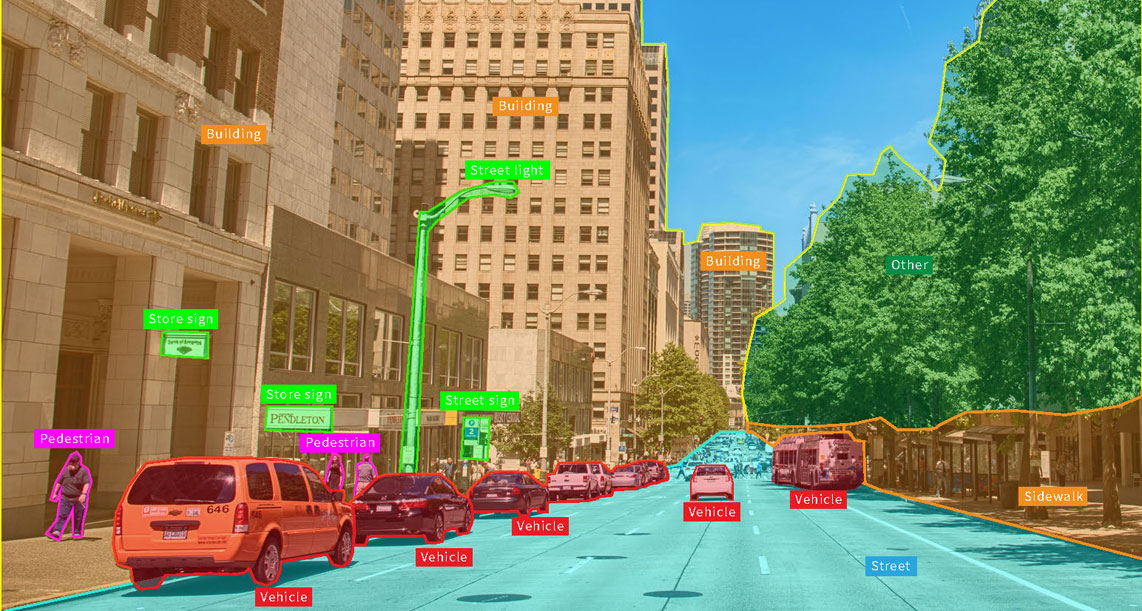
Semantic and Instance Segmentation
- Difference between semantic and instance segmentation.
- Architectures like U-Net, DeepLab, and PSPNet.
- Applications in medical imaging and autonomous vehicles.
Image Generation and Style Transfer
- Generative Adversarial Networks (GANs)
- Variational Autoencoders (VAEs).
- Neural style transfer techniques.
- CLIP (Contrastive Language-Image Pre-Training)